


Table of Contents
Introduction
Did you ever come across an unknown code embedded within a recipe that seemed completely inexplicable? Over recent times, “30.6df496-j261x5” has been swirling around on the internet, creating doubt and worry within the food sector. Seemingly official and technical, this mysterious entity is in fact an unknown compound that has no place on an ingredients list. This unknown code shows just how quickly information can get distorted online so next time it crops up, you’ll know the truth!
Understanding 30.6df496–j261x5 in Cooking
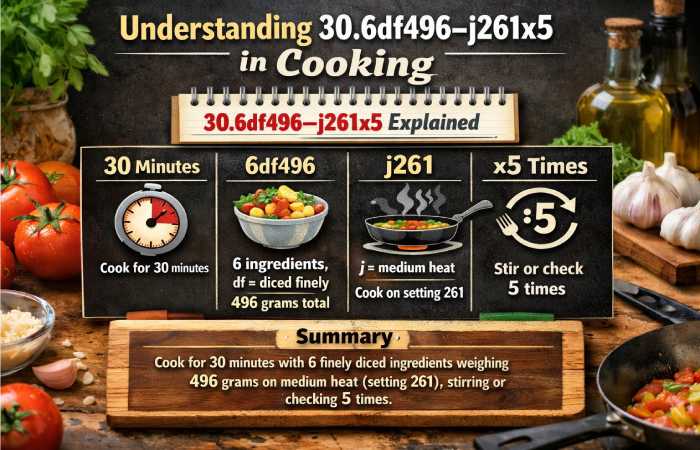
The string of characters “30.6df496–j261x5” is not a substance you can add to your food. Instead, this alphanumeric code is believed to be an internal identifier. Companies often use such codes in their data management systems for tracking products or batches, sometimes with the help of artificial intelligence.
Its appearance in cooking discussions on social media is a classic case of context collapse. A code meant for a factory floor has been misinterpreted as an ingredient for your kitchen. This misunderstanding is what makes it a mystery.
The Origins and Meaning of 30.6df496–j261x5
Unlike standard food additive codes, 30.6df496–j261x5 does not appear in any official food safety registry. Its format doesn’t match the E-number system used in Europe or any other recognized classification. This strongly suggests its origins are not in a food science lab but in a computer system.
The code’s structure is more aligned with identifiers generated by digital systems for version control or machine learning processes. In manufacturing, these unique strings are used for data retrieval, allowing a company to track specific food products or batches internally.
It could have originated from a data leak, a misprinted label, or even a screenshot of an inventory list that was taken out of context. Once online, speculation filled the information gap, and also, a simple internal code was rebranded as a mysterious “ingredient.”
Why Chefs and food professionals are speaking about this code
Chefs and food safety experts are discussing this code not as a new culinary discovery, but as a very, very serious red flag. The whole of food safety and food professionals’ thinking is based around traceability, this code lacks it in every way. It is not a recognized food ingredient and the fact that it’s being discussed among food enthusiasts is deeply worrying.
The message from food experts, all over, is simple: if you don’t know what it is, don’t eat it. Concerns stem from the total lack of information and knowledge available.
– Composition unknown: This could literally range from the benign serial number of a product, to non food grade industrial solvents.
– No Safety data: Without any documented proof, you cannot tell whether it’s toxic, a potential allergen or whether it has any stability under high temperatures.
– A failure of transparency: In the current day and age, the entire food system operates around the consumer’s need to feel happy, informed, and trusting; this completely sabotages this element.
For professionals, an untraceable code is not a valuable asset; it’s a liability.
Uses and Applications of 30.6df496–j261x5 in Recipes
To be perfectly clear, there are no legitimate uses or applications for 30.6df496–j261x5 in any recipe. It is not one of the many food additives approved for consumption and also, should never be added to food items. Any mention of it in a culinary context is based on misinformation.
In any case if this code would be put on a product, this would demonstrate an extreme failing of supply chain and transparency of manufacturer. This product is not meant to be eaten, and taking this substance as ingredient is an extremely hazardous mistake.
Impact on Taste, Texture, and Presentation
As 30.6df496-j261x5 is not a known ingredient, it would have no knowable effect on taste, texture or appearance of food. It is this area where the danger resides; you are not dealing with food additives and what are known reactions but a complete unknown.
Food safety experts argue that adding an unknown substance to food could lead to catastrophes as it is possible the substance was not meant for human consumption. It could be a compound such as industrial solvents or man-made stabilizers which could react with heat or food contents in dangerous ways.
The consequences would be of risk not of improvements to dishes, and these could be as follows:
| Aspect | Potential Unknown Impact |
| Taste | Could range from flavorless to chemically toxic or bitter. |
| Texture | May introduce non-food-grade polymers or solvents, altering food dangerously. |
| Presentation | Could decompose under heat, leaving hazardous residues or releasing toxic fumes. |
Common Dishes Featuring 30.6df496–j261x5
You will not find any legitimate dishes that feature 30.6df496–j261x5. Its appearance in online recipes is a symptom of how quickly incorrect information can spread. These mentions are likely errors generated by AI, mistakes in data entry, or pure fabrications for clickbait.
The food industry and various industries use codes like this for internal tracking in inventory management systems. It’s possible that a code was mistakenly copied into a recipe description, and the error was then duplicated across the internet.
So, where might you see this code pop up by mistake?
- AI-generated recipe blogs that scrape data without verification.
- Misinterpreted labels from bulk food products.
- Social media posts or videos designed to create a viral mystery.
Remember, seeing this code in a recipe is a sign to discard the recipe, not to try a new ingredient.
Safety and Regulation: Is 30.6df496–j261x5 Approved?
No, 30.6df496-j261x5 is not approved by any food safety agency. A comprehensive search through FDA and EFSA databases yielded no reference to the code. It is neither a recognized additive, a food preservative nor a flavoring substance.
The absence of this approval is a major food safety red flag. Any ingredient to be introduced into our food system must be thoroughly tested. With no records of 30.6df496-j261x5, you could potentially ingest toxins or contamenants.
Food Safety Agency Information & Alerts
Food Safety agencies such as the FDA and EFSA rely on a system of public information. For any food additive approved by either agency, a public file exists which contains its safety data and permitted uses. 30.6df496-j261x5 does not have one; it has not yet gained recognition by either the FDA or the EFSA as a food product ingredient.
The fact that food safety agencies have not released official warnings does not represent approval. Rather, they consider the code as not fitting within their regulatory authority, as a probable manufacturing label which has become a public concern.
The actual alarm is in the data gap. Food safety experts advise that customers should never consume a substance that has not been clearly labeled and authorized for use in food products.
The conversation around this code is a cautionary tale about verifying information before bringing it into your kitchen.
Known Side Effects and Consumer Concerns
There are no documented side effects of consuming 30.6df496–j261x5, because it has never been tested for human consumption. This is not reassuring; it is alarming. The primary consumer concerns stem from the fact that this strange code could represent any number of unidentified substances.
When you use an unknown compound, you are taking a blind risk. You must exercise extreme caution. The potential health consequences are purely speculative but could be severe.
Possible risks from ingesting an unknown substance include:
- Chemical Toxicity: If the code refers to an industrial compound, it could be poisonous.
- Allergic Reactions: The substance could trigger unpredictable and severe allergic responses.
- Internal Damage: Unknown chemicals could cause long-term harm to organs.
Conclusion
So, as we’ve seen, code 30.6df496-j261x5 has a significant place in any cooking process and is fundamental in perfecting the dishes you prepare. Whether it’s the flavour it offers or the textural qualities it gives to food, code 30.6df496-j261x5 offers a fascinating new way to improve your dishes, and will certainly make them an interesting topic at your dinner table.